“Cast your burden on the Lord, and he will sustain you…” (Psalm 55:22).
I’m in the middle of a 3-part series that I’ll return to soon, but I ended my last post saying we left the high places (from our trip to Switzerland) and hit the ground hard back in the valley! In so doing, we’ve been talking about “casting” a lot – “casting” our cares on the Lord (1 Peter 5:7) and remembering His perfect love “casts” out fear (1 John 4:18), thinking where in Scripture we find the command to “cast”!
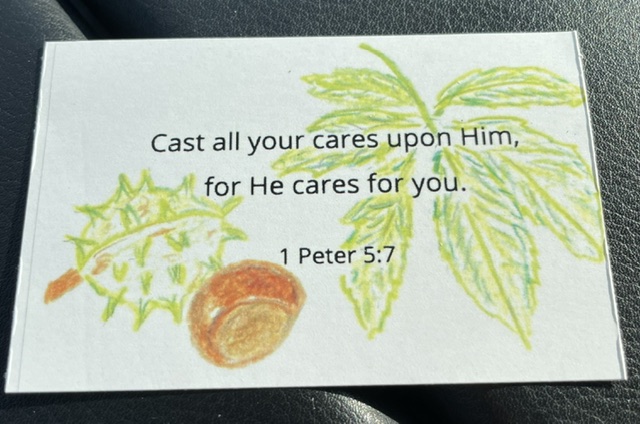
While there in Switzerland, we saw this cute church in Lauterbrunnen and visited. They had a bowl of business-size cards for guests to take. I debated whether we should take one, perhaps making sure to leave enough for others. My daughter handed me one, and I slid it into my purse pocket and forgot about it.
I was shopping yesterday and looking for my credit card in my purse pocket and found this stuffed in there. It was a sweet reminder from our time at that beautiful church and of our need to cast our burdens, cares, and anxieties on the Lord who cares for us!
I looked at the church website and saw this quote from Jochen Klepper, who I see online was a prominent German Christian writer, journalist, and one of the 20th century’s most significant Lutheran hymn writers:
“You who hold time in Your hands, Lord, take up the burden of this year as well and turn it into blessing. Now that the center has been firmly established by You in Jesus Christ, lead us toward the goal. You alone are called the Eternal One, knowing beginning, end, and center amidst the fleeting passage of our times: remain graciously turned toward us and lead us by Your hand, that we may walk securely.”
Whatever you are carrying today, remember the Lord cares for you, and you have the perfect place to cast your cares!
While I was shopping yesterday, I also heard this song twice, back-to-back on one radio station and then another. What a great reminder that “What You said on the mountain is still true in the valley”!
The photo above was taken by my daughter at the end of our recent trip to Switzerland. She texted it to me, I think to capture the hotel at night. I almost deleted it because it was so dark and hard to see. However, upon a closer look, unbeknownst to her, I could see the photo captured three very meaningful themes in my life from the last couple of years. I’m hoping to recount each theme in a series of posts in the coming days. This is Part 1 of 3.
My husband led student trips to Switzerland (and Italy) for about 15 years (around 2003-2018), so it’s very near to his heart. In 2010, I met him at the end of one of those trips, but it rained the whole time, and I couldn’t see the mountains! He also had an injury, which was challenging, that I wrote about here. So it was great to return to these beloved places and visit them again, this time with our daughter. (Our son, who wasn’t able to go with us, had been many years ago with the students, but she had never been.)
Because my husband loves to travel and has done so extensively, he is our planner. He knows the areas and prepares thorough itineraries. In this case, when we first started talking about Switzerland, I looked online to a town he had mentioned, saw a hotel that captured my attention, and thought it was pretty. He said, “Let’s go there.” And just like that, it was settled. We would stay in one place and go out from there on day trips in Switzerland and France.
In the weeks leading up to our trip, I was studying Habakkuk with a Bible study by Dannah Gresh. It concluded in the days leading up to our trip with Habakkuk 3:19:
God, the Lord, is my strength; he makes my feet like the deer’s; he makes me tread on my high places. To the choirmaster: with stringed instruments.
Many years ago, the Lord had revealed Himself to me as my strength, so that’s always a special reminder.
Simultaneously, we had deer visit our backyard. We would watch them leap through the barbed wire fence at the back of the yard with great agility. They were out in the street when cars came, and they leapt through the yard running from the danger. With these visuals, I could understand more about “feet like the deer’s”!
I shared in our family text that the deer matched my Bible reading, and my mom said it reminded her of the book Hinds’ Feet on High Places. I considered buying the book for the trip, but I decided against it. However, the day before, my mom brought me a copy she had, so I took it along.
To reach our hotel, we had to travel up a mountain on a narrow, winding road, often without visibility of what was coming around the corner. It was a stressful drive. Upon arriving at the hotel, my fears came into play. What was the altitude? Could we manage that road up to it over and over again? Where were we?! How had we not realized its location on such a high place? Why did I ever suggest this place?! How could we have missed doing proper research?! You could say that I was “Much-Afraid.”
I began reading Hinds‘ Feet on High Places as part of my morning devotional time while we were there. It was unbelievable how precisely it felt written for this exact moment in my life and all of its circumstances. The book, based on Habakkuk 3:19, is about the transformation of the main character, “Much-Afraid,” who learns to live with strength in the Lord (rather than fears), is taken to the High Places with the Lord, and is given a new name.
When she sets out, leaving the Valley of Humiliation for the High Places, the Shepherd provides her with two companions, Suffering and Sorrow. Much-Afraid gasps:
“I can’t go with them! I can’t! I can’t! O my Lord Shepherd, why do you do this to me? How can I travel in their company? It is more than I can bear… Couldn’t you have given Joy and Peace to go with me, to strengthen me and encourage me and help me on the difficult way? I never thought you would do this to me!”
After her tears and outburst, the Shepherd asks gently:
“Joy and Peace. Are those the companions you would choose for yourself? You remember your promise, to accept the helpers that I would give, because you believed that I would choose the very best possible guides for you. Will you trust me, Much-Afraid? Will you go with them, or do you wish to turn back to the Valley…?”
Much-Afraid looks into the face of the Shepherd and knows she cannot doubt him or refuse. She will go with Sorrow and Suffering. The Shepherd adds:
“Fear not, Much-Afraid, only believe. I promise that you shall not be put to shame. Go with Sorrow and Suffering, and if you cannot welcome them now, when you come to the difficult places where you cannot manage alone, put your hand in theirs confidently and they will take you exactly where I want you to go.”
Along the journey to the High Places, Much-Afraid learns lessons of “Acceptance-with-Joy,” “Bearing-in-Love,” of humility, forgiveness, and love. She is transformed from limping to leaping. She is renamed “Glory and Grace.” She is able to return to the Valley to do the Lord’s work, now strengthened by Him.
These are only a few highlights of this beautiful book, without giving away too much such that you couldn’t read and enjoy it too!
Returning to Habakkuk 3:19, I remembered the Lord God is my strength, He makes my feet like the deer’s to tread on my high places, and I return to the last sentence, “To the choirmaster: with stringed instruments.” If you study Habakkuk, you also see him go from questions and wrestling to embracing the God he can trust. It seems to end with a hymn that he has written to be sung, with instruments.
As I thought of transformation in my own life, I was reminded that my name means “Joyful Song” or “Joyful Spirit.” In fact, it’s a diminutive form or feminine counterpart to the name Charles, meaning “Strength” or free-man. Though I often live as “Much-Afraid,” the Lord calls me to live in His Strength, to sing His song, to be full of Joy. Could I be transformed as well, as I go with Him to the High Places?
I have stood in awe of the Lord, how He gave me the visual of the deer in advance, how He unexpectedly took us literally up on high place where my fears were exposed, how He gave me a book that was written precisely for me in that moment.
And to my further amazement, at the end of Hinds’ Feet on High Places, when reading the author’s personal story and background, I discovered the author Hannah Hurnard had written it during a 3-week visit to Switzerland in 1949! She shared how the story came about, about the Alps, even small things like her fears of riding the gondola, which I also had to conquer that week! On and on, I felt like my very life was being written about and spoken to in such particular ways!
Some deer statues on our hotel property
Though it’s hard to see in the photo at the top of this post, this deer statue is in the foreground, in the middle, right in front of the white outdoor furniture. This is the first theme then of the photo: how the Lord enables us to tread on our high places.
We came back down to the valley after the trip. Life with all its ups and downs resumed. A few minor medical things and sickness. Sometimes after beauty in a high place, we do feel as though we hit the ground again with a thud! And yet, through it all, I praise and love the Lord, my Strength, who is so personal and loving, who teaches us how to tread on our high places as we trust in Him! Praise Him!
During summer, when Bible studies at church or BSF have ended for the year (typically running from September to May), I tend to pick up studies I have around the house and study a book of the Bible myself, using that study to go along with it. My husband previously worked for a Christian publisher who published a number of excellent women’s Bible studies, and I have copies of most of them to pull from. This summer, I’ve been looking at Habakkuk with Dannah Gresh.
After I posted my last post on Daniel, the day’s lesson in my Habakkuk study was about Daniel! Dannah Gresh wrote about similar themes, and I thought I’d quote some of what she said which might reinforce my last post:
“It seems the plan of Nebuchadnezzar was to bring all the influencers to his capital so he could indoctrinate them. Rather than the back-breaking slavery the Egyptians used to put the Israelites into bondage, Babylon would use education, opportunity, and good food as seduction. That doesn’t sound like captivity. (It sounds like college.) It was what you might call friendly captivity. There’s nothing more dangerous! The king of Babylon sought to keep his captives living and breathing, but very dead to who they were in God.”
Dannah goes on to write about the change of Daniel’s, Shadrach’s, Meshach’s, and Abednego’s Hebrew names:
“These four golden exiles had Hebrew names that identified them with God. Daniel’s name meant ‘God is my judge.’ Hannah meant ‘God is gracious.’ Michael meant ‘Who is like God?’ And Azariah meant ‘God has helped.’
One of the first things the king’s eunuch did was change their names. Belteshazzar meant ‘protector of the king.’ Shadrach meant ‘commander of the Moon God.’ Meshach meant ‘What is what Aku is?’ Abednego meant ‘Servant of Nabu.'”
She concludes:
“My friend, we live in a proverbial Babylon. Oh, the names of the gods are different but be sure of this: the city that claimed our captives is a word picture and lesson for us…. The enemy has a plan for your time in Babylon, surely as God does. His is to steal, destroy, and ultimately to kill you (John 10:10). But he seems to always start with renaming you.
“The enemy does not just want you to forget who God is. He seeks to create so much amnesia in your life that you aren’t even sure who you are.”
Dannah goes on to share some of the ways Satan has tried to change her name and identity, encouraging the reader to do the same: ask God to show you any names the enemy has given you and begin to replace them with God’s truth.
The enemy really does strike at our identities, using all that culture offers, to try to rename us, remake us, and attempt to keep us from knowing who we are in Christ. Let’s stand on God’s Word and truth.
Have you heard the new Brandon Lake / Nick Jonas song, The Author? They ask, “Who am I. Who am I…” Don’t we all need to know who we really are? In Christ, it’s something beautiful! (See Ephesians 1-3.)
When life is going well, it’s not hard to live lives of faith. Everything is happy! It’s not hard to believe in a good God.
But when life is hard, when suffering enters, when hardship comes, when challenges emerge (as we are assured they will this side of heaven) — this is when our faith is really lived, when “the rubber meets the road” of our faith. In the testing, in the suffering, God refines us, shows us where our faith lacks, and if we trust Him, makes us stronger in Him and in faith through it. This is when the journey walked with Christ becomes real and exciting! This is opportunity.
And here’s the clincher: the outcome of these trials and hardships, though important, do not matter as much as the faithfulness of God to us in them and our seeking to be faithful to Him in response. In these moments, we can declare that God IS good, no matter what comes to us, because He is in fact good and is faithful.
We have an example of this in Daniel 3. You may know the familiar story. The pagan king Nebuchadnezzar builds a golden statue and commands that all worship it. Shadrach, Meshach, and Abednego refuse. (Cue the children’s song in many of our minds!)
Note: their real names were Hananiah, Mishael, and Azariah (Daniel 1:6-7). When taken into captivity in Babylon by King Nebuchadnezzar, they, along with Daniel, were given names intended to honor the false gods of Babylon. The intent was to change their identities, to have these men assimilate into this Babylonian culture. They were trained for three years in the Chaldean language and literature to serve in King Nebuchadnezzar’s palace. They were chosen as ones for these roles of serving in the king’s palace because they were “some of the Israelites from the royal family and from the nobility….”
Let that sink in for a minute. They were selected for these roles, targeted if you will, because of their royalty. The enemy, the Babylonians, were looking for the best of the Israelites to bring under their tutelage and instruction, to assimilate them into their ways. Does this sound familiar?
As Christians, we are royalty, a royal priesthood, a chosen people of God’s own possession (1 Peter 2:9). There is an enemy who will target us (John 10:10; 1 Peter 5:8). Ephesians 6:10-20 reminds us that our enemy is not against flesh and blood, but “against the rulers, the powers, the world forces of this darkness, the spiritual powers of wickedness in the heavenly places.” And the enemy today seeks to bring people under his delusions and control, using all kind of forces for training them up, from media to worldly ideology. We must be aware of these schemes if we are to stand against them.
Let’s also take a moment to be thankful for faithful preachers and teachers who not only teach God’s Word, but live it, who have not capitulated to the demands of our culture, but who stand firm on the Word of God. Encourage and pray for them.
Right from the start of their captivity, Daniel, Hananiah, Mishael, and Azariah refused to be like the culture around them (Daniel 1). And the Lord blessed them. God gave these four young men knowledge and understanding and wisdom. (Daniel 1:17)
Back to Daniel 3, King Nebuchadnezzar made this 90-foot gold statue to which the people were to fall down and worship when music played. Some took the occasion to maliciously accuse Shadrach, Meshach, and Abednego who would not worship the statue. They were brought before the ungodly king Nebuchadnezzar and told they would be thrown into the furnace of blazing fire if they did not worship it.
Maliciously accused. Brought before an unjust king. Thrown into the fire. Things weren’t looking good.
King Nebuchadnezzar asked, “Who is the god who can rescue you from my power?”
Shadrach, Meshach, and Abednego give this beautiful reply:
“O Nebuchadnezzar, we have no need to answer you in this matter.If this be so, our God whom we serve is able to deliver us from the burning fiery furnace, and he will deliver us out of your hand, O king.But if not, be it known to you, O king, that we will not serve your gods or worship the golden image that you have set up” (Daniel 3:16-18).
In his fury, Nebuchadnezzar charged that they would be thrown into the fiery furnace, set 7 times hotter. The strongest soldiers who threw them in died from the flames. When Nebuchadnezzar looked into the flames, he saw four men walking in the fire unharmed. When they were brought out of the furnace, “the fire had not had any power over the bodies of those men. The hair of their heads was not singed, their cloaks were not harmed, and no smell of fire had come upon them” (4:27). Nebuchadnezzar ends up blessing God who had delivered them!
These godly young men stood strong in the Lord and in their faith in Him. They didn’t waver, even when circumstances looked bleak. They were able to do this because they had earlier resolved in their hearts (see Daniel 1) to follow and serve the only true God. When the moment of testing came, they were ready. They didn’t decide He wasn’t worthy of trusting when these bad times came. Instead, they knew He was absolutely worthy and declared that even if this didn’t turn out like they would hope, they nevertheless would serve no other gods or bow to them.
I hope none of us are ever maliciously accused, brought before an unjust ruler, or thrown into a fire! But it’s actually quite possible when there is an enemy after our faith, our souls, the “accuser of the brethren” (Revelation 12:10), who deceives and seeks our harm, our callings, and our influence for Christ in the world. This is not flesh and blood, but the world forces of wickedness. We must learn to stand up. To believe. To trust. For Christ Himself will stand with us, as He stood in the fire with them, and fight our battles. Think of the story they had to tell when they emerged from the fire! A story we are still telling today.
Let this encourage you, no matter what you are walking through, to trust your worthy Savior. To praise Him in and for the opportunities, the testing of your faith, to prove His worth and faithfulness, to give glory to His name.
“Consider it all joy, my brothers and sisters, when you encounter various trials,knowing that the testing of your faith produces endurance. And let endurance have its perfect result, so that you may be perfect and complete, lacking in nothing.” James 1:2-4 (NASB)
This past year (2025-2026) in Bible Study Fellowship (BSF), in the “Exile and Return” study, we studied 8 books of the Bible, including Daniel (Lessons 3-8 in Fall 2025). I’m going back to record some of my observations from the study. If you are interested in studying the Bible with others in BSF, go to bsfinternational.org to find a group for next year (2026-2027). They will be studying Romans. There are in-person and online options available, and registration is now open.